The Parallel Testify Suite
Why stretchr/testify's Suite cannot run parallel tests, and how a generics-based fork fixes it
You can find the repository here - testify.
The stretchr/testify suite is the closest thing Go has to JUnit-style test classes. It gives you SetupSuite/SetupTest/TearDownTest hooks, a baked-in assert/require, and each Test* method runs as a proper subtest, so go test -run TestSuite/TestOne works. It is a lot of boilerplate removed.
There is one giant hole though: you cannot run your tests in parallel. Call t.Parallel() inside a test method and everything quietly breaks - teardown runs before the test body, and the whole suite shares one mutable struct across goroutines. Parallel support has been requested upstream over the years and closed as not planned, because doing it properly needs breaking changes.
This project is a fork that fixes exactly that. It keeps the same hooks and the same ergonomics, and the whole suite - tests and subtests - becomes parallel-safe.
Why parallel() doesn’t work there
Two independent problems, and either one alone is enough to sink it.
One instance, shared by every test
The original suite runs all test methods against a single instance of your suite struct. Before each test it just swaps the context in place:
1
2
3
4
5
6
7
8
9
10
11
12
13
14
15
16
17
18
func Run(t *testing.T, suite TestingSuite) {
	suite.SetT(t)
	// ...
	for _, test := range tests {
		t.Run(test.Name, test.F)
	}
}

// inside the per-test function:
F: func(t *testing.T) {
	parentT := suite.T()
	suite.SetT(t)          // one shared instance, one shared `t`
	defer func() {
		// ... teardown ...
		suite.SetT(parentT)
	}()
	method.Func.Call(...)
}
That is fine when tests run one at a time. The moment two tests run in parallel, both SetupTest() and the user’s test body write per-test data onto the same struct, and both tests fight over the same t for their assertions. Data races and garbled test output are guaranteed.
Teardown via defer runs too early
This is the subtle one. All teardown in the original is wired with defer, including suite-level teardown:
1
2
3
4
5
defer func() {
	if tearDownAllSuite, ok := suite.(TearDownAllSuite); ok {
		tearDownAllSuite.TearDownSuite()
	}
}()
Now recall how Go schedules parallel subtests: when a subtest calls t.Parallel(), it pauses - the code after Parallel() has not run yet. The parent keeps going and eventually returns. Only after the parent test function has fully returned do the paused tests get scheduled to run.
In the original suite, the “parent” is the suite’s Run function. So with parallel tests, this happens:
RunlaunchesTestOne,TestTwo, …- Each test method calls
t.Parallel()and pauses. Runfinishes its loop and returns - and its deferredTearDownSuite()runs right now.- Only then do the parallel test bodies actually execute.
Teardown before the tests have even started. This is precisely why Go 1.14 introduced testing.T.Cleanup: cleanup functions are guaranteed to run only after the test and all of its parallel subtests have completed. defer cannot give you that ordering; Cleanup can.
What about TestMain?
The knee-jerk answer to all of this is “don’t use a suite, write it by hand with the stdlib’s TestMain”. That gets you exactly one thing - package-level setup and teardown:
1
2
3
4
5
6
func TestMain(m *testing.M) {
	setUpDatabase()
	code := m.Run()
	tearDownDatabase() // runs after every test, parallel ones included
	os.Exit(code)
}
(Note the teardown runs before os.Exit - os.Exit skips deferred functions, so defer tearDownDatabase() here would never run.)
But the suite-shaped problems are all still yours:
- Only one
TestMainper package. Two declarations is a compile error. A package with several suites has to funnel every one of them through a single main, and routing several unrelated setups through it is yours to manage. - Forgetting
os.Exitis a silent pass. IfTestMainreturns without calling it, the binary exits 0 having run nothing. - No per-test structure.
SetupTest/TearDownTest, assertions, and test grouping are hand-rolled in every test function. There is no-run Package/TestGroup/Subtesthierarchy - you get a flat list of tests and build the rest yourself. - Per-test teardown ordering is unsolved.
TestMainfixes package-level teardown, but inside a test function relying ondeferhits the exact same parallel-subtest problem - you’d still reach fort.Cleanup, by hand, in every single test.
So TestMain is the right tool when you have one piece of shared setup for a package. The moment you structure tests into groups with per-test and per-subtest lifecycle, you are reimplementing the suite - badly, and one bug at a time.
The fix: an instance per test, teardown via Cleanup
The fix has two parts, and generics make the first one possible.
A fresh suite instance per test. The suite type is now a generic *suite.Suite[T, G] embedded in your struct. Every test and every subtest gets its own new(T) - its own testing.T, its own assert/require, its own per-test data fields. Nothing is shared between parallel tests, so there is nothing to race on.
All teardown via t.Cleanup. TearDownTest, TearDownSubTest and TearDownSuite are registered with t.Cleanup(...), which the testing framework only invokes after every parallel subtest has finished. The ordering the original suite could never get - teardown after all parallel work - now comes from the testing package itself, in the correct LIFO order.
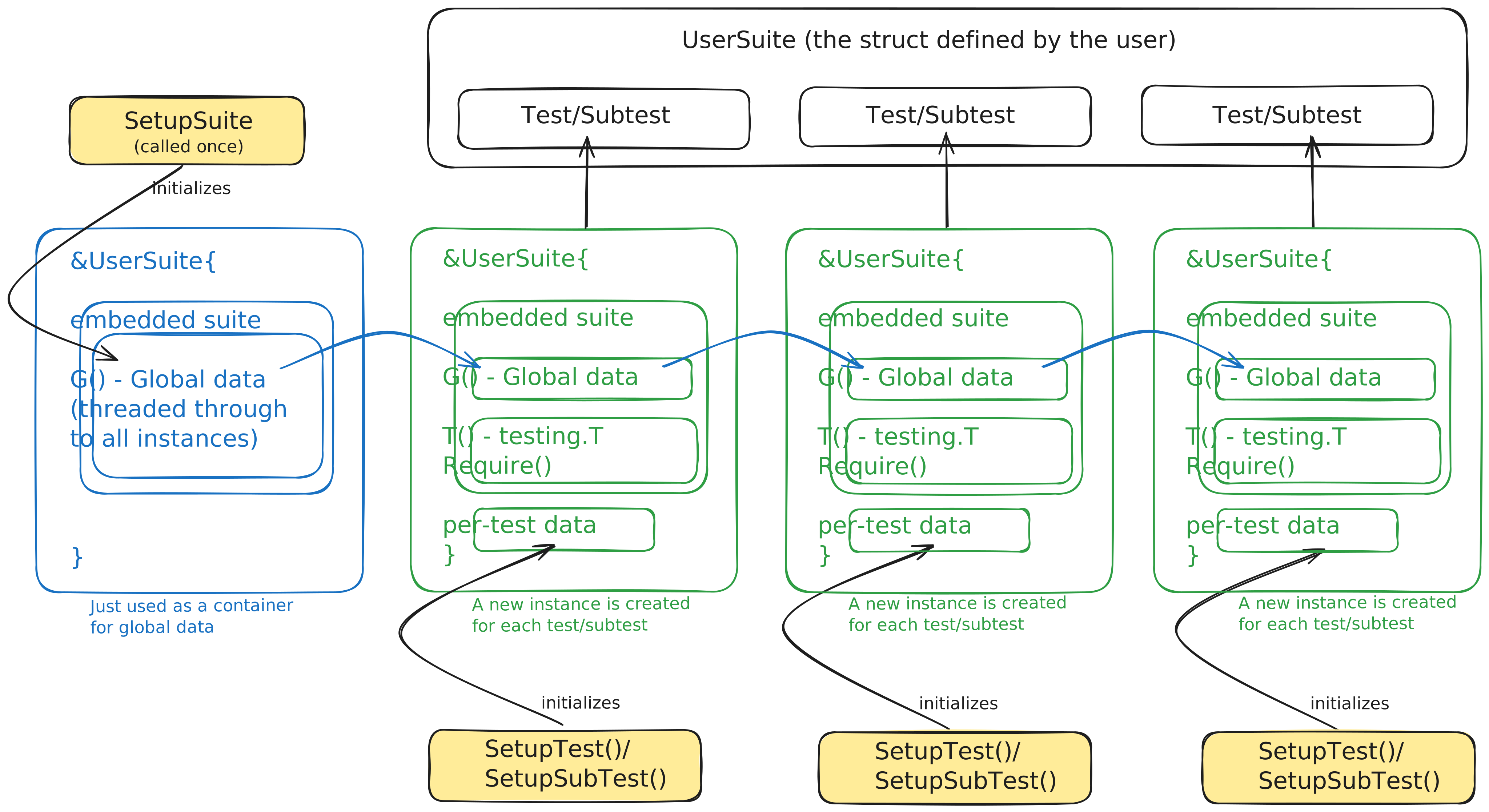
Global and local data
Parallel tests need some isolated state, and suites need some shared state. The two generic parameters make the split explicit:
1
2
3
4
5
6
7
8
9
10
11
12
type OrderSuite struct {
	// This must be embedded.
	*suite.Suite[OrderSuite, GlobalData]

	// Per-test data - unique to each test/subtest.
	priceCalc *PriceCalculator
}

// Global data - one instance per suite run, shared by all tests.
type GlobalData struct {
	DB *sql.DB
}
Local data lives on the suite struct and is zero-valued for every new test instance. Global data lives in G and is created once per Run, then threaded through every instance - set it up in SetupSuite, read it anywhere via s.G().
What it looks like
1
2
3
4
5
6
7
8
9
10
11
12
13
14
15
16
17
18
19
20
21
22
23
24
func TestOrderSuite(t *testing.T) {
	t.Parallel()
	suite.Run[OrderSuite, GlobalData](t)
}

func (s *OrderSuite) SetupSuite() {
	s.G().DB = connectToTestDB()
}

func (s *OrderSuite) TestOne() {
	s.Parallel()                          // this just works now
	s.priceCalc = NewPriceCalculator()    // per-test data

	for _, v := range []string{"sub1", "sub2", "sub3"} {
		s.Run(v, func(sub *OrderSuite) {
			sub.Parallel()                // parallel subtests, nested
			sub.T().Log(sub.G().DB.Name())  // global data is shared
		})
	}
}

func (s *OrderSuite) TearDownSuite() {
	s.G().DB.Close()
}
go test -run TestSuite/TestOne/sub2 still works, because every test and subtest is a real subtest. The -testify.m method filter works too, plus a new -testify.x flag that does the opposite - exclude tests matching a regex.
Trade-offs
- You own global data synchronization.
SetupSuiteruns before any test starts, so reads ofGare safe everywhere, but if two parallel tests mutate the same global field, that is a race you must lock yourself. - One semantic change you will hit: subtest instances are zero-valued, so data set in
SetupTest()is not copied into subtests. Reach back to it explicitly viasub.Parent().someField. - Go 1.18+ for generics.
- VSCode CodeLens needs an (otherwise useless) blank import of the original
stretchr/testify/suitepackage. It exists solely so vscode-go shows “run test” / “debug test” actions inline above eachTest*method - a quirk of the extension.
The testing package got the hardest piece right in 1.14. All this project does is stop fighting it: one instance per test, Cleanup for teardown, and explicit global data. The suite you know, minus the “cannot run in parallel” asterisk.